I suppose I could rightfully be accused of thinking too often that I can solve a problem around my house with the application of just a little more technology. Guilty as charged. But for some problems, technology is the best answer, or the only rational answer.
Nicholas Negroponte is also a “TO.” I love the vision of the One Laptop per Child organization he helped to found, to “empower the world’s poorest children through education” and to provide that education, in part, by providing
each child with a rugged, low-cost, low-power, connected laptop. To this end, we have designed hardware, content and software for collaborative, joyful, and self-empowered learning. With access to this type of tool, children are engaged in their own education, and learn, share, and create together. They become connected to each other, to the world and to a brighter future.
I bought two of these XO laptops, for my two older children, when the devices first came out. The organization had a “Buy One, Get One” campaign at that time. I would have called it a “Buy Two, Get One” campaign, though, because you paid for two devices and only received one. The other one went to a child somewhere the organization was deploying them, generally in conjunction with federal governments. Each “pair” of laptops cost $400 at the time. They were really nifty devices, so well thought out for their purpose like no commercial product could be. They were designed to be serviceable and rugged. The screen was an amazing piece of technology developed just for the XO — it was a color display, but had a monochrome mode that was enabled by turning the backlight all the way down. And in the monochrome mode, the screen was completely readable in the bright sun. This was important to them, because in rural African villages, which were one of their target “markets” that’s where school is held!
The devices were also designed to work together to provide a “mesh” network, so that if there was internet access in a village, the laptops themselves could extend the network outward to homes. They also came up with innovative chargers, and other adjunct bits of support technology. Later on, I bought a third one from a friend who had bought a couple, but wasn’t using one.
In the end, my kids treated the devices more as toys than anything else, at least in part because they had easy access to computers at home that were much more powerful. And I happily donated the three back to the foundation. They continue to work on innovative hardware and software to help spread knowledge and educate children.
So today my Twitter Feed had a link to an IndieGoGo campaign that sounded intriguing and very “TO” — the Lantern. This is a nifty, pocket(ish) sized device that receives all kinds of content over a satellite link, and can provide a wifi hotspot that any wifi enabled device can connect to in order to consume the content. It’s not an “active” connection to the internet, but rather acts like a web server with static content. They plan to provide the content of wikipedia, among many other things, including near real time news and weather info. This can help in areas where other infrastructure has been affected, or where governments restrict access to the internet. And as it’s a broadcast technology, nobody can easily track who’s receiving the data. They compare the drive to get these devices out to people like Andrew Carnegie’s building of public libraries, and it’s not hard to see why.

 on Mount Royal. It really is an amazing shrine, and many people were passing through at the same time as us. Many healings there have been attributed to
  and had some savory crepes as well as some chocolate crepes for dessert. In addition to the food, they had a foosball table, books, and other time passers. With that accomplished, we did get back on the road to NY. One thing we were pleased to have accomplished was not using the car during our stay in Montreal. We walked (a lot), and took the Metro (some), and even biked once (well, some of us). Our lodging was ideal for this, located within walking distance of a number of Metro stops, and much of what we wanted to see.


 and the artists on Place Jacques Cartier.
 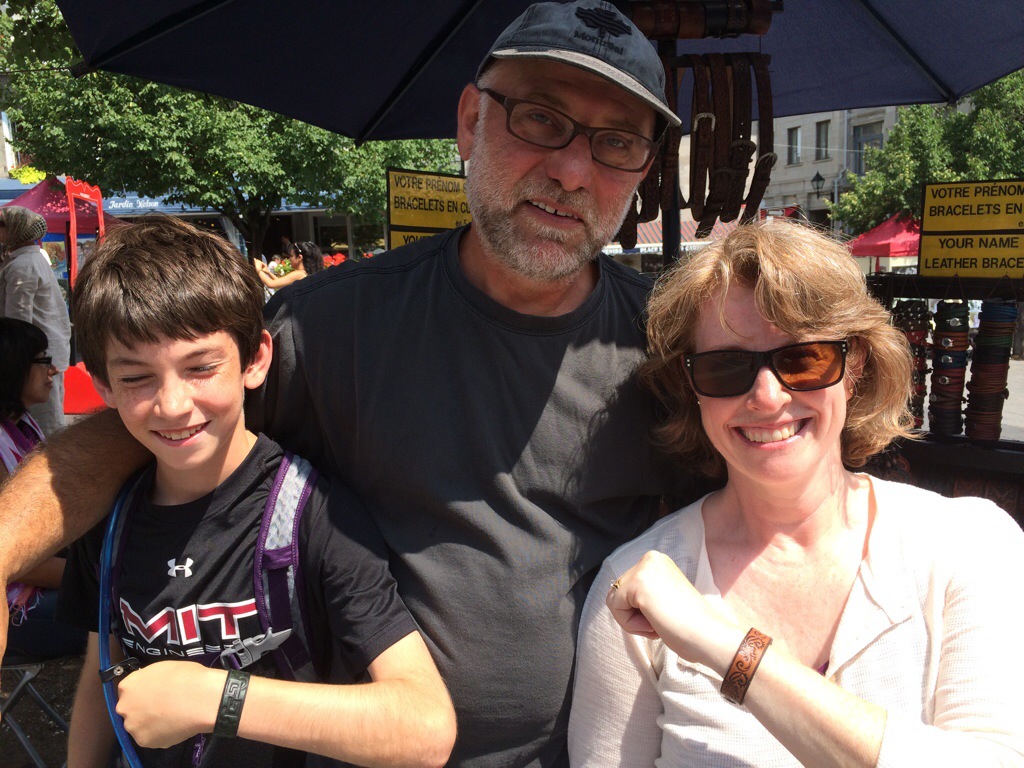 We ended up eating lunch at a restaurant where the rest of the family ate lunch last time they were in Montreal, then we walked down to the Old Port and enjoyed more little shops, etc. Afterwards, we wound our way back through the Old Port,
 found an ice cream shop on a side street en route to Notre Dame, where we stopped to take photos.
 Then back to our cozy apartment where we cooked a simple dinner of pasta and Caesar Salad.

