Blog

  • Ireland

    Ireland

    TL;DR — we vacationed in Belfast and Dublin for six days.

    The day after the tournament was over, we took a lovely express bus to a regional airport, and took a smallish plane, for a shortish time, to travel to Belfast. (When was the last time you got to walk out on the tarmac to your plane?)

    We only had one full day in Belfast, plus the half day after our arrival, and a half day preparing to leave. We walked around the city that first evening, taking in the City Hall

    and Saint Anne’s Cathedral

    The next day, we took a bus tour that took us to one of the major attractions that drew us to Belfast — the Giant’s Causeway. On the way, we got to see the ruins of Dunluce Castle

    which was used (with some CGI enhancements) as Pyke Castle, home to the House of Greyjoy in Game of Thrones. And then we got to the Causeway. And wow was it breathtaking! I would have to say it was the most unique and interesting geological site I’ve been to. The notable feature is the collection of some 40,000+ hexagonal columns of basalt, which were formed by lava cooling very slowly and uniformly, which apparently caused fractures to form hexagonally.

    The tour bus gave us a reasonable amount of time to explore, and the only challenge was that it was raining lightly much of the time, which left the surface of the rocks rather slippery. Our tour guide told us there were two stories about the formation of the structure, a “boring” one involving slowly cooling lava, and a more colorful one involving giants. The story with the giants did not in any way explain why there were hexagonal columns, so personally, I prefer the boring one.

    On the way back, the bus stopped at another GoT filming site — the Dark Hedges, which is known in the series as the Kingsroad. That was striking and picturesque as well.

    The last stop on the tour was the Titanic Experience museum, which documented the history of shipbuilding in Belfast, the design and construction of the Titanic and her sister ships, her launch, and the story behind the disaster. It was really well done and fascinating.

    Completely coincidentally, we were in Belfast on the days leading up to The Twelfth, and saw one of the bonfires under construction just a few blocks from our hotel. Here are two photos, one from the evening of the 10th, and another about 12 hours later, on the morning of the 11th, when we were leaving.

    Bonfires are lit on the night of the 11th. On the 12th itself, parades apparently make it very challenging to get around the city, so we were glad that our plans had us leaving the morning of the 11th.

    From Belfast, we took a train to Dublin. It was just over a two hour ride, which was pleasant enough through the picturesque Irish countryside. I knew when I booked the tickets that there were reserved and unreserved seats on the train, and I (of course) purchased the less expensive unreserved. I was envisioning this manifesting as some cars having only reserved seats and others being completely unreserved, but that’s not how it works. Each seat has a status indicator indicating whether it is reserved or not (and for what part of the trip). This meant that you really want to arrive on the early side to ensure that you can find seats together, facing forwards (if that’s your preference) and with space for your luggage. It all worked out fine, but was a little more stressful than I had anticipated.

    In Dublin, our schedule called for two full days, plus two half days for traveling. On our arrival day, we again did quite a bit of walking around, finding St. Stephen’s Green

    near our hotel, which was reminiscent of Central Park, though at a very different scale, and browsing some of the many knitwear shops.

    We visited famed Trinity College, where we were able to see the exhibit on the Book of Kells, which was also very well done, as well as the famous library,
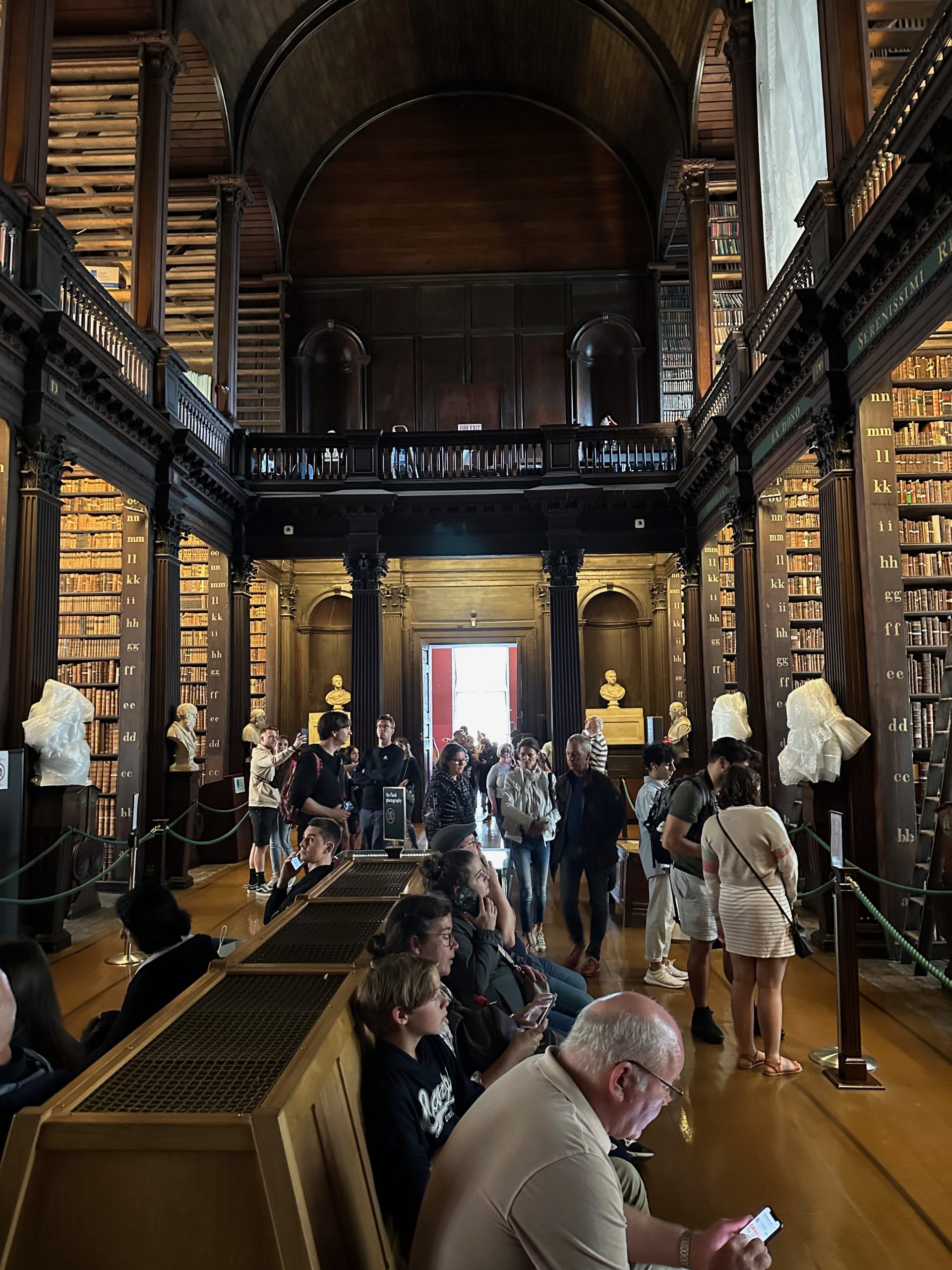
    which was in the early stages of major restoration work, and therefore devoid of most of its books. But Susan got to say hello to Rosalind Franklin there

    and later, I got to have my first Guinness in its birth town.

    On our first full day, we once again took a bus tour. This one took us from Dublin, on the eastern coast all the way west across the country to Galway, on the Atlantic coast. Our stop in Galway was really focussed on the very touristy section that was all about shopping and eating. Which was OK for such a brief visit, since we needed some lunch anyway.

    On the way there, we got to stop at the (in?)famous Barack Obama Plaza truck stop, which was a little weird, but apparently his third great-grandfather lived in the area before emigrating to the U.S.

    The next stop was the geological gem of the day — the Cliffs of Moher, which among other things is famous as the “Cliffs of Insanity” from The Princess Bride movie. There was a nicely developed walking trail safely set back from the edge, which we walked on for a stretch, but not the entire 18 km length! As in much of Ireland, the trail was directly adjacent to grazing lands for cattle and sheep.

    When developing the site for tourism, they very cleverly built gift shops directly into the landscape, which was cool.

    We subsequently had two stops in the area known as The Burren. The first was right along the coast, where we got to experience the terrain up close, which is largely exposed limestone.

    Speaking to the barrenness of the area, it was famously stated that in The Burren, “there is not enough water to drown a man, wood enough to hang one, nor earth enough to bury him.” The second stop was at Kilmacduagh monastery, a lovely collection of ruins.

    Our second full day in Dublin coincided with our wedding anniversary, and we got the celebration off to a fine start with a walk to breakfast at a quaint little café called Two Pups, which included some appropriately decorated beverages.

    From there, we walked to the Guinness brewery at St. James’s Gate and took their self-guided tour, which was quite extensive, educational, and fun. One of the little highlights was the nine thousand year lease that Arthur Guinness signed for the plot of land on which he built his brewery.

    Others included some history of cooperage (barrel making), including a video that documented the process, and a fun intro to drumming on a Bodhrán,
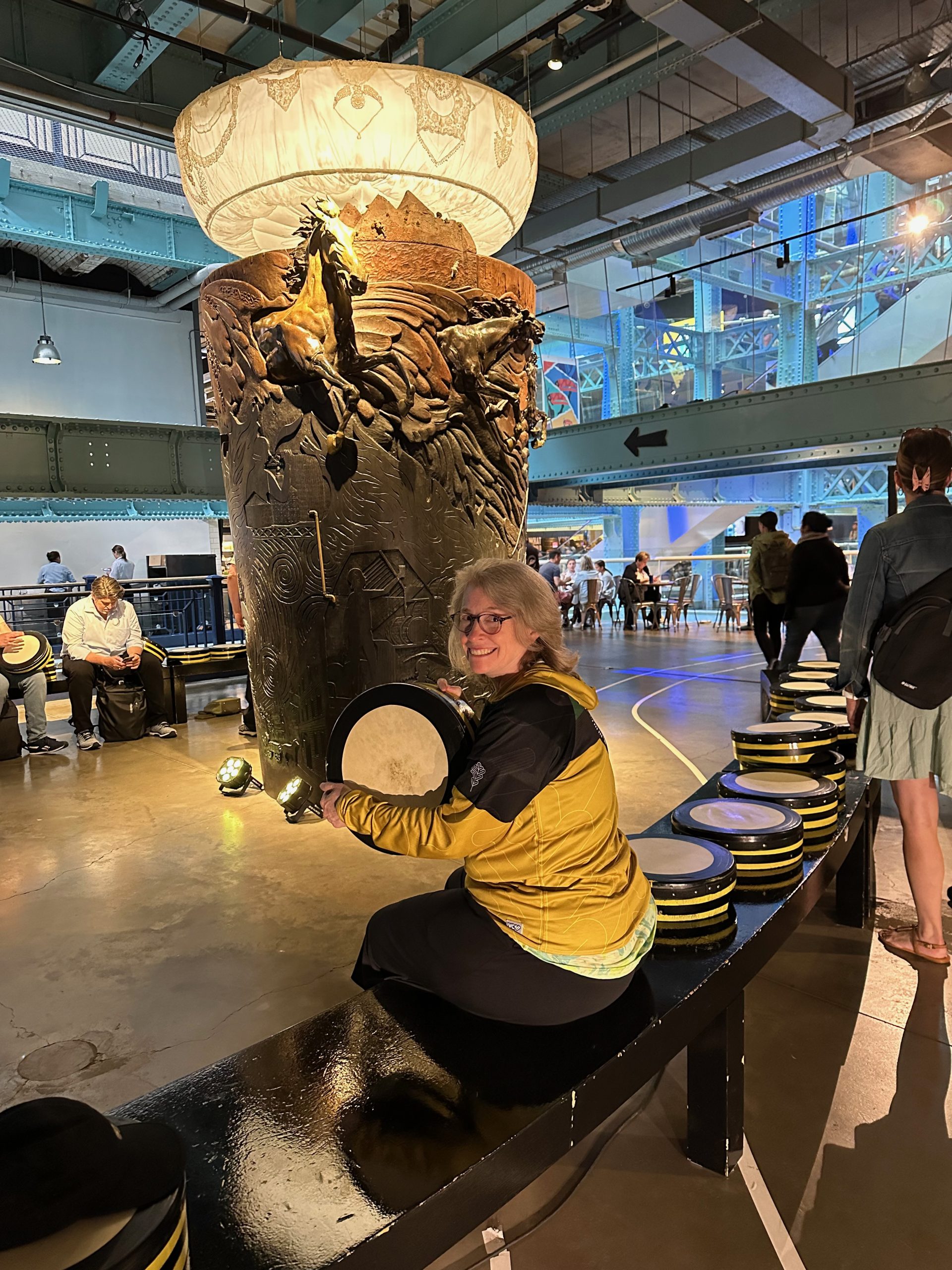
    even if any connection to Guinness was lost on me. Along the way, we did learn about brewing, about Arthur and his family, the history of the company, etc. We spent over three hours leisurely walking through the exhibits, which culminated with a lesson in beer tasting, and finally a “free” pint (or half pint, if preferred)

    in the pub at the top of the building, which had lovely panoramic views of the city.

    After that, we exited through the gift shop, and gleefully spent way too much money, for the privilege of advertising on behalf of Guinness.

    After a quick “toastie” for lunch, we next made our way to the Irish Whiskey Museum, where a very opinionated and humorous guide instructed us in the history of Irish Whiskey and its superiority over all other Whiskies (especially Scotch). We then got to sample three (Susan) or four (me) different whiskies.

    Well done, even if the guide was a little over the top.

    The highlight of the day, though, was definitely attending a production of Fun Home, an autobiographical musical written by graphic novelist and creator of the unintentionally famous Bechdel test, Alison Bechdel. It was a powerful and tragic story of a young woman discovering her sexual identity, and subsequent learning about her father’s closeted gay identity. Heavy and moving material. We happened to walk past the theater the previous day, on our way to the bus tour pickup, and Susan noticed it was playing, and mentioned that it had been on her list. So we bought tickets on the spur of the moment, after vanquishing a recalcitrant website for ticket purchases.

    The next morning was simply packing for the trip home and getting to the airport. Our travel went as smoothly as possible. The plane that was arriving in Dublin to fly us to Boston left New York almost three hours late, but there was enough slack in the schedule that we ended up taking off only about fifteen minutes late, eventually arriving fifteen minutes early and having to wait for a gate in Boston! We were able to clear customs in Dublin, which meant that we arrived as a domestic flight, and with only carry-on luggage, we were able to walk out of the terminal, and catch a Silver Line bus just as it was arriving. That took us to South Station, where a Red Line train was just arriving! The “big delay” came when we got to Harvard and had to wait about three minutes for the 77 bus to arrive. And that gave us an entire weekend to recover!

    A great vacation, though obviously too short to get to know either of those cities meaningfully.
  • The Ultimate Trip to England

    The Ultimate Trip to England

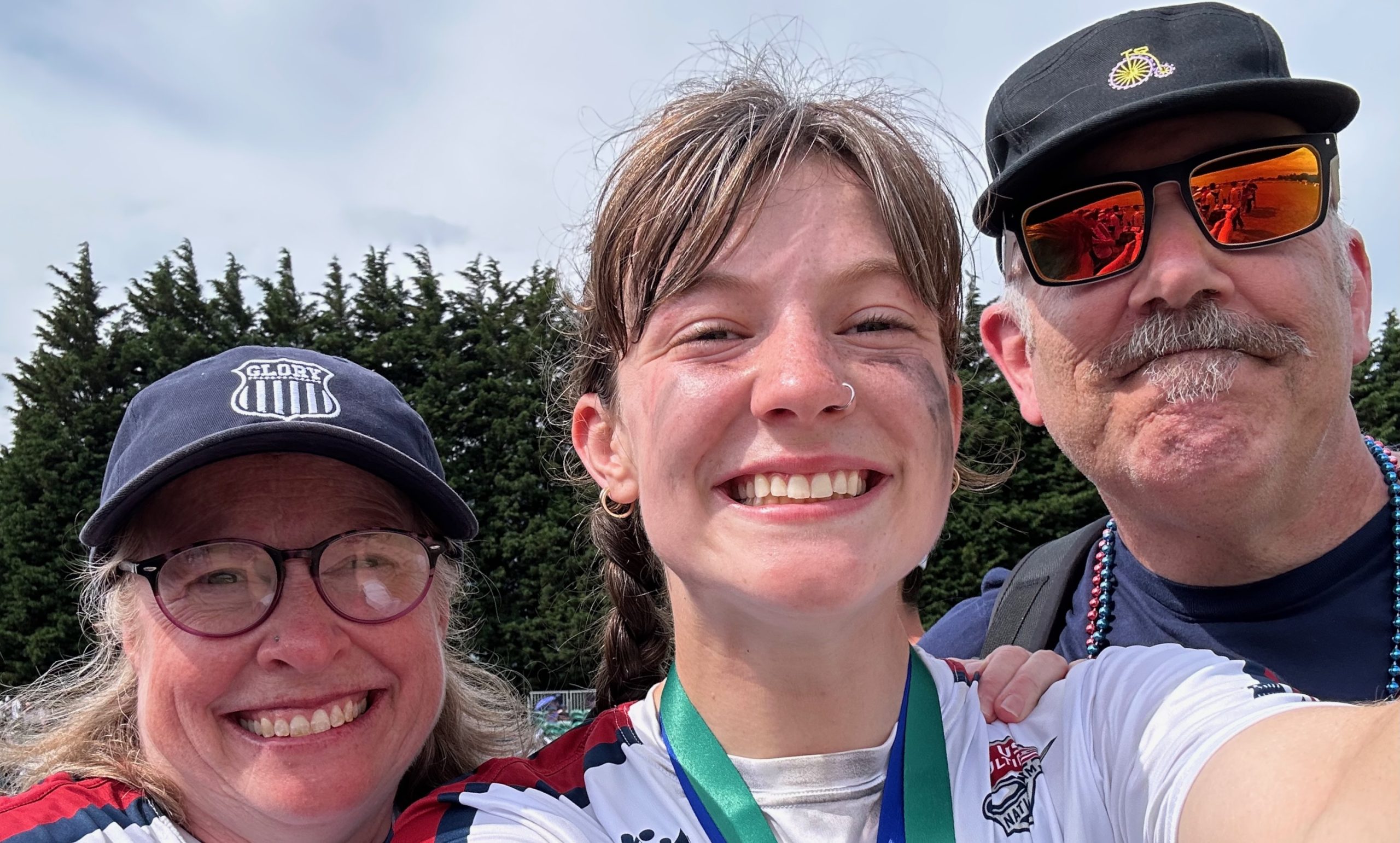
    You may be sensing a theme here in my titles. This time, we have followed Clara to Merry Olde England to watch her play in the WFDF World Under-24 Championships in Nottingham. Each (interested) country fields up to three teams — a Women’s (W) team, a Mixed (X) team, and an Open (O) team. The Open teams are generally all male, but the division is Open to all.

    I have endeavored to support my children on their journeys with sport to the best of my ability, and when the younger two hit upon Ultimate Frisbee, it was something of a revelation. There are three core values (that I see) that really differentiate Ultimate from other sports. First is Spirit of the Game, which is (I am not quoting chapter and verse here; just summarizing from a layperson’s perspective) all about sportspersonship and fairness — valuing spirited competition over the final W/L result. Players of both teams celebrate good play, regardless of side, as do fans. Well, at least players and fans who were brought up with the tradition. In general, it is an integral part of the coaching and training, but there are always outliers. I can remember attending one high school matchup where it felt like we were playing a hockey team that had just been given a disc and the rules of how to score. They were just bullies on the field, and their parents were just as vociferous and mean-spirited as the worst of youth sport parents. It felt exceptionally foreign and jarring, given my other experiences with the sport. In general, you would be very hard pressed to find a more collegial group of competitors.

    The second value that I see displayed over and over, is inclusivity. The Open division is truly open to all, though honestly, after high school where there is often only one team, you see few non-male players on an open team. But there are plenty (never enough, to be sure) of women’s teams, and what’s unique in the sport (well, I confess, I am not much of an expert) is that they have a mixed division (ok, ok, mixed tennis doubles comes to mind, ice skating, ice dancing, etc, but can you name other large team sports?) In this tournament, there were 22 countries represented, with 14 sending Women’s teams, 15 sending Open teams, and 16 sending Mixed teams. 10 countries fielded teams for all three divisions, but nine countries sent just one team, and of those nine, six were playing in the mixed division only. In what other sport would you see that? Many of the sponsors are vocal supporters of diversity and inclusivity.

    The final value that makes Ultimate special, is that it is almost exclusively self-refereed. Players call fouls on each other, and on themselves at times. When there is a dispute about a call, the players must work it out, and when they can’t, the disc goes back from whence it came, and play continues from there forward — a do-over of sorts. At some tournaments, there are now “observers,” who are there to assist the players working out disputes, and who may, if the players request, and if they had a good view of the incident, make a call. Watching players have to work things through is really pretty inspirational. You do not see tantrums, or hysterics. There is no “bad guy” (ref) to blame for bad calls. That aspect of play is simply absent. It is again something that is core to the values of Ultimate frisbee — fair play — and it is taught and encouraged at every level.

    At the end of the tournament, the three US teams racked up a combined record of 27-0 and each came out on top of their respective divisions, which is honestly par for this particular course. But for the first time, a US team also won their division’s Spirit of the Game award — the mixed team! After each game, each team sits down and awards points to the other in five categories: Rules, Fouls, Fairness, Attitude, and Communication. Add those five categories up, and you get a spirit score, and average that score over the games played, and the team with the highest score wins the Spirit of the Game award, and this award is represented with a trophy and medals for the players, just like coming out on top of the competition.

    But really, I came here to celebrate Clara and her team. As I mentioned in passing, the team didn’t lose a game, but not only that, they won with an average margin of victory of 10 points. That bests the Open team’s average margin (9) and the Women’s (8). So, for them to beat their competition so soundly, and still earn the Spirit of the Game medal is really pretty astounding.

    Here’s another observation. If you were to look at the player stats for the championship bracket, which the US team clearly dominated, you won’t see a US player on the board until 11th place (Go Henry!!) To me, that points to a supremely well-rounded team, where everyone is contributing. And there are lots of reasons for this, of course. First, the US has a deep pool of exceptional Ultimate players to pull from. But equally important (at least!) was the coaching staff, who were simply outstanding. This team had one weekend together about four weeks before the tournament, and they came a week before the competition started to get some practice together. And in those 9ish days, the coaching staff molded three exceptionally cohesive lines of eight players, and they pretty much rotated those three lines. Since there are seven players on the field at a time, one of those players sits out. They did have to deal with injuries and illness (Covid strikes again!), but they kept with this system throughout the tournament, and it certainly seems to have paid off. They also emphasized love and family in their community. We could not have asked for better!

    All in all, it was a glorious week of watching Clara and her teammates shine. Congratulations to them, and to the rest of Team USA!!

  • The Ultimate Road Trip

    The Ultimate Road Trip

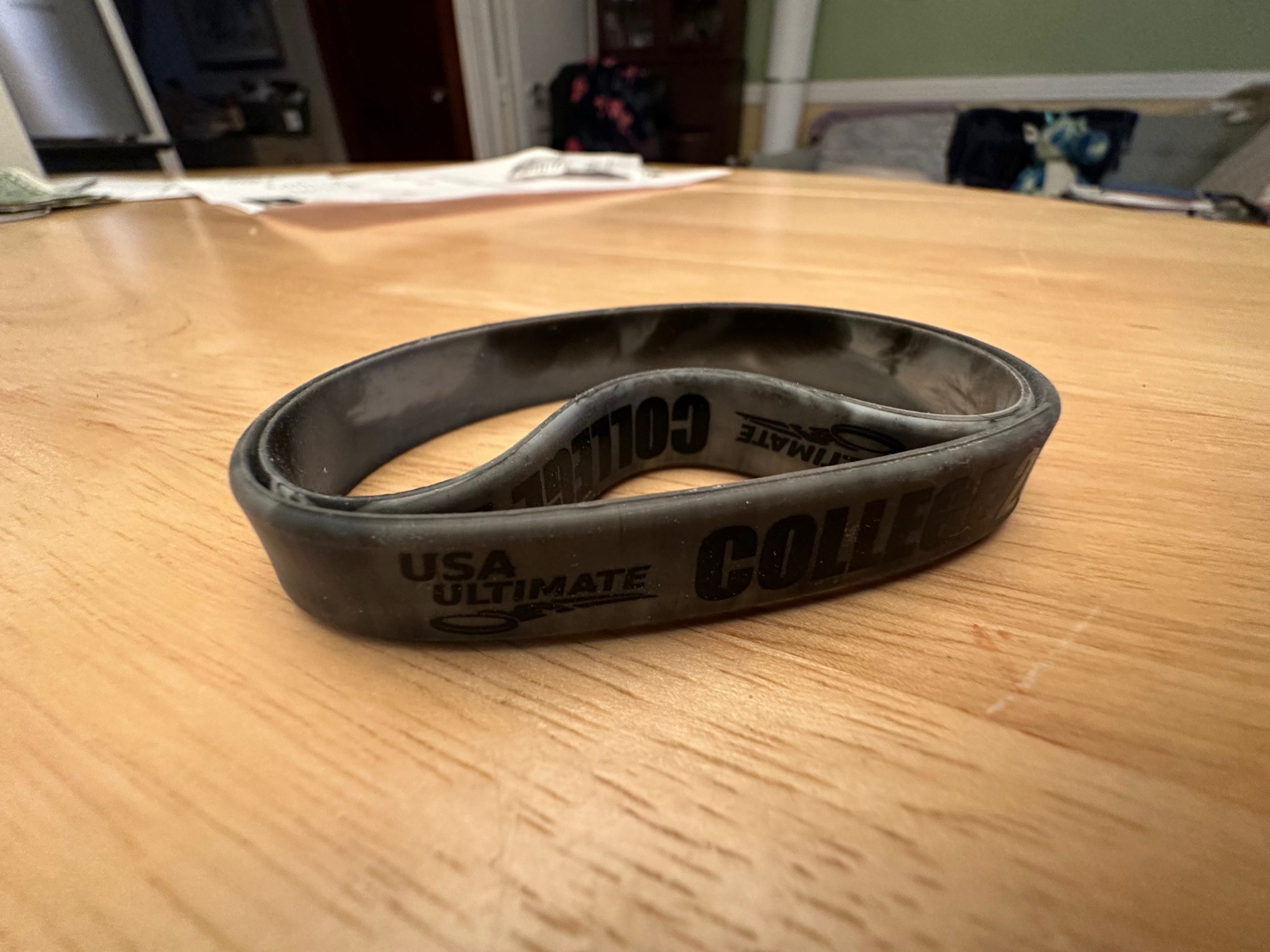
    Our wristbands for entry into the tournament

    Well, we finally did it. Susan and I managed to get to watch Clara play in this year’s USA Ultimate Collegiate Championships. Her Northeastern University team, the Valkyries, have played at nationals 3 of the 5 years she’s been there, and of course, there were no nationals (or much of anything else) in 2020 and 2021. Clara’s team nominated her for a Callahan Award, and the best part of that is that they put together a highlight reel for voters to watch to assist in their evaluation of the candidates. All the videos are amazing, of course, but Clara’s is superb! This year, the tournament took place in Ohio, which seemed like a manageable drive. After we both were done with work on Thursday afternoon, a little before 3:00 p.m. we got in our car and headed west. We drove as far as Rochester, NY, getting off the road at around 10:00 p.m. We awoke the next morning at 5:00 and were back on the road by 5:30. We drove straight thru, with one fuel stop, to Mason, OH, just outside Cincinnati, and arrived minutes before the 1:00 p.m. opening pull in their game against Virginia. Just enough time to get our folding chairs, and a cooler full of Gatorade (and pickles!) for the team, out to the field.

    In this first game, Northeastern was seeded higher, and they did win with a final score of 9-8, which tells you it was a hard fought game that ended due to hitting the hard cap, rather than one team reaching 15 points.

    In their second game, against Georgia, the Northeastern Valkyries did not fare so well, eventually losing to the lower-seeded team, 9-14. That was a tough loss for the Valks, and they were not feeling great afterwards.

    On Saturday, after a night’s rest, they first faced higher seeded Stanford, and played a good game that ended with the Valks on the losing end of an 815 score. Not especially close, but the Valks played well, and felt good afterwards. That led up to their final game of pool play, which was against #2 seed Colorado.

    It was another well played game, and by half time, the Valks were down 6-8. In the second half, they managed to fight back to a 10-10 tie, then take the lead at 11-10. They pretty much traded points after that, and came away with the W in a nail-biter at Universe Point (15-14 final). That victory earned them a spot in the pre-quarters, and knocked Virginia out of contention (which Georgia somehow felt the need to Tweet about bitterly!).

    In their pre-quarter game against Carleton, the Valks started out in a 0-2 hole, but dug themselves out and went into the half ahead 8-6. But the second half ended up being more Carleton than Northeastern, and the Valks finished their season with a 10-15 loss. But they seemed quite pleased, as well they should, with it being their first visit to pre-quarters since 2008. Colorado, by the way, went on to play in the finals against North Carolina. The game is available on Ultiworld if you have a subscription.

    The game against Stanford was on the field that they were streaming from, so the game is available on YouTube if you care to watch. Watch the point starting at 1:11 for a lovely highlight.

    We also got to watch some of the later championship games and hang out a bit with Clara

    The athlete and her proud parents

    And Susan got to work on her vert:

    Disc was at about ten feet — impressive, no?

    The weekend involved driving a little over 1,800 miles spread over 4 days. It did not go well for the bugs who insisted on getting in our way.

    Time for a bath…
  • Design for Serviceability

    Design for Serviceability

    Panasonic Microwave

    About an hour into a brief, twenty-four hour getaway, I received a not quite panicked call from my mom, letting me know that her microwave (a Panasonic NN-SN733W, bought in August 2015) wasn’t working. She uses the microwave all the time, for heating up water to make tea, and even making a good percentage of her meals. It’s probably the most used appliance in her apartment. Which is mildly ironic, considering how dubious she was of the idea when I bought her her first one. She was a bit disappointed that I wouldn’t be able to deal with it that day, but in the end was accepting of the situation.

    So today, after coming home, one of the first things I did was to take a look at her microwave. And as she had told me, it seemed completely dead — no clock, no light, no nothing. The outlet it was plugged into was good. I explained that generally appliances don’t fail like that. Maybe the turntable motor would fail, or the magnetron, or the control panel. But given that there was zero sign of life, it seemed likely that it was an internal fuse that had blown. So, I began to take it apart. There was one Phillips screw on the bottom of one side holding the shell of the case on, which I removed. But the other half-dozen screws were all security Torx screws! A sign that the manufacturer definitely didn’t want a consumer opening it up (but why have the one plain Phillips? That is a mystery…).

    When I got it open, I could see that the power supply circuit board did indeed have a fuse on it, and the fuse was in a fuse holder, rather than being soldered to the board. Hallelujah! There was hope! It was a ceramic fuse, though, so it wasn’t immediately obvious whether it was blown or not. But a quick check with an ohm meter showed it had blown.

    After returning from the hardware store, about 10 minutes later, I popped the new fuse in, and plugged it in briefly, just to see if the clock would come on, etc. And sure enough it did. So, I unplugged it, put everything back together properly (or nearly so), and had mom try it by heating a cup of water. And it worked! So, all is good, at least for the time being, and another microwave has been saved from the landfill/incinerator.

    But this begs the question — why?? Why make it so that the average consumer couldn’t replace the fuse? Why not make the fuse accessible without taking the whole shell off? A fuse is, or should be, a “user serviceable part.” I can’t quite imagine what the rationale is for making it this way. Is it in the hopes that people will just toss it and buy another? Why not solder the fuse to the board then? Is it to help keep appliance repair shops in business? Seems vaguely plausible, but unlikely.

    I do have the sense that a generation (or two…) ago, people were more accustomed to fixing some things themselves. I am also aware that those “things” were significantly simpler then. An electric stove had a power cord, and from there, the wires went to a bunch of resistive heating elements through a simple, electromechanical control, turning on and off various combinations of heating elements. And a thermostat for the oven. If there was anything else, it was a clock that operated on the 60 Hz AC signal. There were no circuit boards with touch panels, and fluorescent displays to break, which would have to be replaced in whole if something failed. But a fuse? Why bury that where it is unlikely to be discovered except by the most intrepid of owners. While I do appreciate the forward leaps we’ve experienced in functionality, I do believe a lot more could be done to make appliances more serviceable.

  • Another of My Favorite Things

    Another of My Favorite Things

    Maybe this is a series?

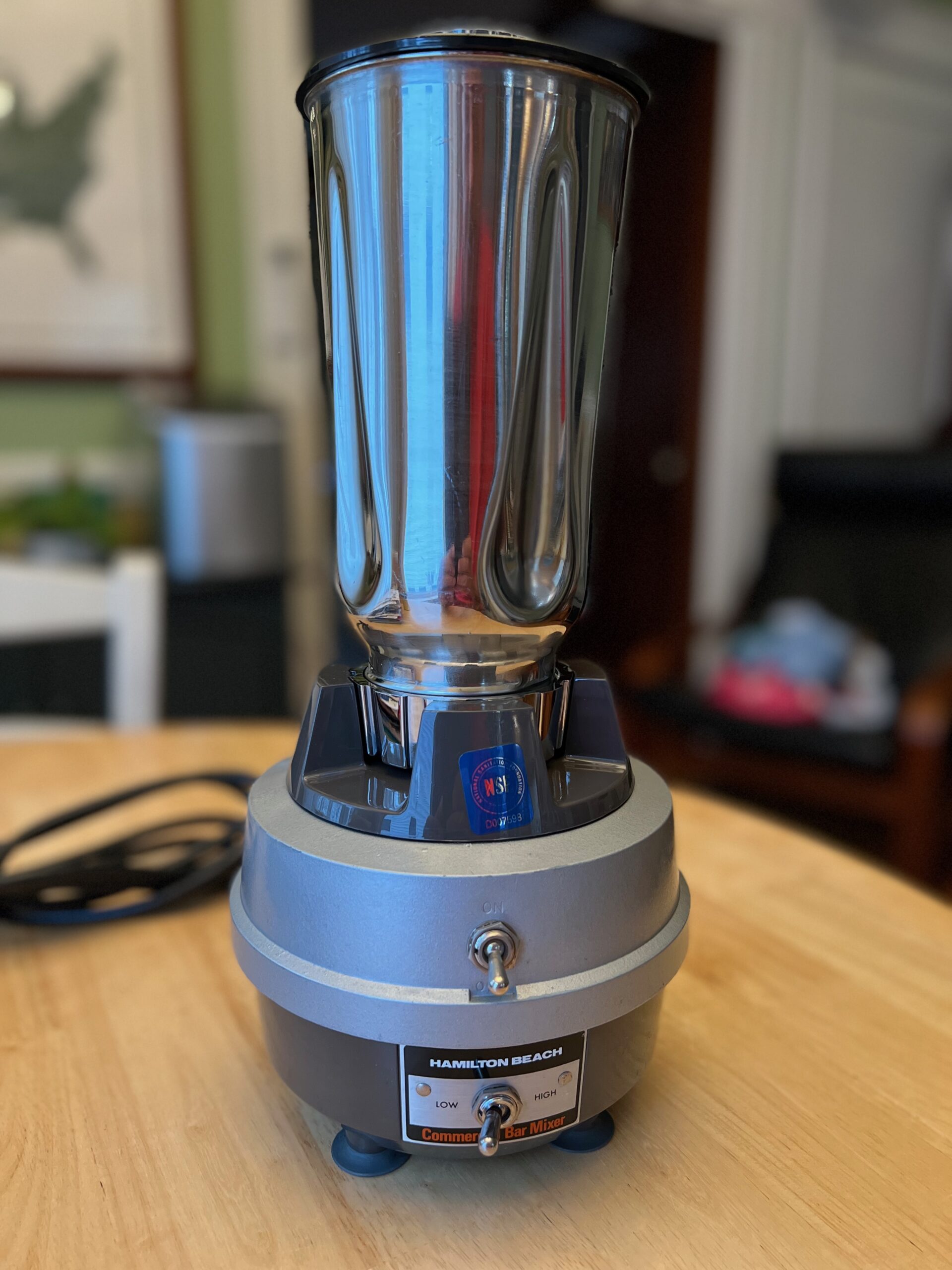
    Hamilton Beach HBB 909

    Growing up, my parents had a 14 speed blender — I think it was a Hamilton Beach. Each of the speeds had a name — things like blend, whip, puree, mix, etc. I think it had 7 buttons for the speeds, and a “High/Low” range switch that selected one of the two banks of verbs. I can only imagine that a marketing person had the job of coming up with 14 different verbs that defined some form of mixing, and somehow implied greater or lesser speeds. My parents hardly ever used it, though. It wasn’t something either of them was familiar with, so mostly it sat on the countertop looking modern (compared to the rest of the items there). They had received it as a gift from the realtor who sold them the house.

    Fast forward 15-ish years, with me in my first post-college job, and wanting a blender, mostly for making drinks that involved chopping up ice into tiny bits. So I wanted something heavy duty. I worked in a part of Boston that had a fair number of commercial kitchen suppliers nearby, so I went to one of those and purchased the above blender. I have little recollection as to what it cost. I’m sure it was, for me, quite a luxury purchase, but I wanted something that would be sturdy and lasting. This thing has a 3/8 HP motor and is built like a tank (in the U.S. of A. no less!). This would have been around 1990 or 1991. Sometime in its first few years of life, the “clutch” in the actual blending container became pretty stuck, and I went back to the same store and was able to buy just that part. It has been running smoothly ever since. But in the past month or so, the motor wasn’t always engaging with the clutch in the bottom of the container. And once again, 30+ years later, I was able to purchase repair parts for this thing and get it working reliably again.

    My repairs, as is often the case, didn’t go exactly smoothly. First, I was trying to loosen the clutch from the motor by turning it the wrong way. This caused me to take apart the unit a whole lot more than was necessary in the hopes that I could grab onto the other end of the shaft to stop it spinning. This resulted in the motor coming apart way more than I anticipated (brushes came out of the motor housing, even). I think I ended up putting it back together half a dozen times, or thereabouts, due to the motor running the wrong way (!), leftover washer, etc. But, in the end, it did all go back together, and is working well once again, with the clutch engaging well and turning the blades in the blender.

    I really appreciate things like this, that are simply well built, made to last, and made to be repaired. Commercial kitchen equipment is certainly significantly more expensive than home oriented versions, but it can pay off in the long run.

  • Objet d’art

    Objet d’art

    Western Electric 1013

    Not everyone is likely to agree with my assessment of this particular artifact, but in my opinion it is a paragon of industrial design. Perhaps nobody loved the Bell System at the time, but the gear they made (which they owned, and you rented) was made to last for decades, which this example certainly has.

    The above photo is of a Western Electric model 1013 Linesman’s butt set, probably from the late 1970’s or early 1980’s. I have a couple of other, more modern sets in my “collection” but this recent addition is really a prized possession for me, for two reasons. First and foremost, this comes from a friend’s father’s collection of tools, and is a beloved memento for that. Second is the rotary dial, which is just one of the most pleasing devices to operate. This is of course what all phones had for the longest time, but the mechanical engineering that went into creating something so reliable is inspiring. This particular rotary dial is mechanically the same as the one that went into Trimline phones, with the slightly odd movable finger stop, that allowed for a more compact design. But because it was a tool that would see heavy use in this particular context, the number plate was done in porcelain. I find it hard to imagine anyone putting that kind of thought and money into a similar product today.

    I really do find the design both pleasing and functional. The shape is essentially the same as a traditional handset from the era, which is very comfortable to hold, and to rest on the shoulder for hands-free use. But in something that isn’t much larger than a handset, they have managed to incorporate an entire working telephone. Even the rubber pad on this specimen is still pliable, indicating that care went into the selection of materials. The cloth covered wires are still supple and the colors easily distinguished. And who could fail to love the orange color?

  • More on Music… (not moron music)

    More on Music… (not moron music)

    Early in my life, my exposure to music was almost exclusively classical music and opera. At home, we had a semi-portable stereo phonograph, and a kitchen radio. The record collection was, with the exception of a handful of children’s records, classical and opera. The kitchen radio mostly played news from the local NPR station, but also classical. On Saturdays, sometimes my dad listened to latin jazz while doing house cleaning chores. Below is an image (not mine) of a similar player.

    ours was, believe it or not, slightly fancier

    My exposure to popular music essentially began in third grade when we moved from Hamden to North Haven, both in Connecticut. My new best friend there essentially introduced me to popular music. He had a much older brother who no longer lived at home, but some of his records did — Beatles and such. But also their family’s radio was more often tuned to popular music stations. And they had a radio in their car!! My dad was so against the added complexity of having a radio in the car, he seemed ready to pay extra to have it removed when finally it came standard with their next new car (a VW Rabbit). He also was suspicious of the rear wiper, fearing it was just something else that could break. I tried to argue with him based on the number of times he had to have the front wipers repaired (zero, aside from replacing blades…), but he remained dubious.

    Anyway, back to music. While I can’t honestly remember it ever being explicitly stated, I definitely grew up with the sense of popular music, or really modern music of any sort, as being somehow inferior to classical music. And while I feel that the older music that has survived over centuries is the work of genius, I have come to feel less apologetic about finding real musical creativity and perhaps genius in more modern compositions. It’s easy to think of orchestral music as something well-defined, and never changing, but in reality, things changed all the time. The piano was a recent invention at some point. New instruments have always been added, and gradually accepted into more formal settings.

    I remember reading about the creation of the Theremin, named after its creator, Leon Theremin. He saw his invention as a novel and serious musical instrument, incorporating new technology, rather than a tool for creating the spooky, alien sounds that came to fill the soundtracks of 1950’s sci-fi horror movies. Here it is in a more light-hearted setting:

    So if we can accept that the tools for making music must be allowed to evolve, then that allows us (or at least me) to accept modern music as being the work of artists, and in some cases genius.

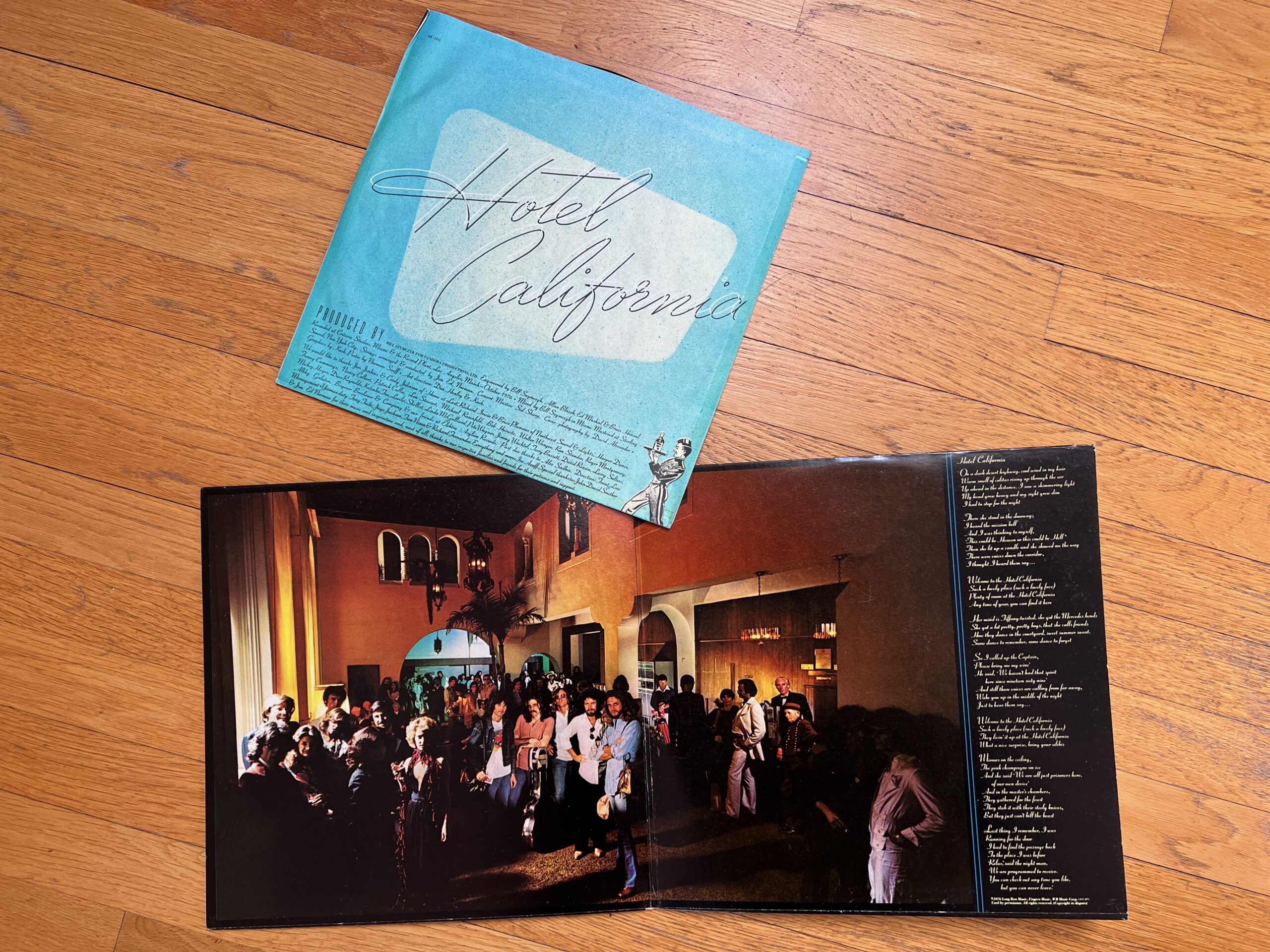
    Back to my personal history with music. The first record I ever purchased was the Eagles’ Hotel California, in 1976. Or it might have been a Christmas present. However it was that it came into my possession, it was my first. I don’t have all the records I ever purchased, but I do still have that one

    I of course listened to it over, and over, and over. Apologies to my family — it was before headphones were an option for me.

    I did not have much money then (who did?), but a lot of what I did have went into buying records. And when, eventually, I earned more money by raking leaves, shoveling driveways, delivering papers, etc., I was able to save up for a “stereo system” with a built-in 8-track tape player, from Radio Shack (of course). It was something like this:

    not exactly, but a lot like

    Eventually, I saved up for a turntable (not Radio Shack, but I honestly don’t remember the brand. I do remember it had a ceramic cartridge, rather than the preferred magnetic one, because that was what the input on the receiver was built for.) And finally, headphones (definitely from Radio Shack, with two volume sliders on one of the cups.)

    But again, let’s get back to the music. One of my favorite bands of all time was, and continues to be, Pink Floyd. They combined powerful songwriting with a profound ability to push the envelope in terms of what sounds could be incorporated into music. In the days of recording on analog tapes, they would splice tape into precise loops for certain sounds, and incorporate recordings from the field into their music. Their albums as well tended to constructed as a singular, thematic whole, rather than a collection of unrelated songs.

    But don’t trust me on the music — listen to Doug, an admitted Classical Composer:

    I am inclined to believe that if the composers of classical music had the tools available to them that we do today, they would not advocate for limiting the definition of music to the sounds that could be made from a collection of 20-30 different instruments. They would, as they did, allow themselves to bring their artistic vision to reality using all the tools available.

  • The Blizzard of ’22

    The Blizzard of ’22

    Late on Friday evening, 28 January 2022, it began to snow, and it snowed for about 22 hours straight. By the time I walked the dog around 7:00 a.m. on Saturday, there were a few inches in some spots, but a lot was bare, owing to the winds. The bulk of the snow came during the next 12 hours. We live between Burlington, which reported 22″ as of 7:30 p.m. Saturday, and Cambridge which reported 14″ as of 4:30. But certainly a fairly significant amount of snow fell after 4:30. As with many such events, it is hard to measure snowfall due to the wind. We had patches that were bare, and drifts probably up to 3′. And even though it was quite cold, and the snow was dry, the wind really packed it pretty densely in some areas, so it was heavy and rather hard to move.

    The night before, I attempted to start our snow blower. I hadn’t used it this season, and I don’t remember using it last season, though it’s certainly possible that I did. I didn’t run it dry, but instead put in the requisite fuel preservative. I know they say that ethanol free gas is better for such things, but I don’t see it for sale around here. Mind you, I haven’t done extensive research, but if it’s out there, it’s not obvious. Anyway, the snow blower wouldn’t start. Small engines and I are not on the best of terms, so I asked my neighbor to take a look. He had rescued my old one a couple of times before, and seems quite competent around such things. We tried a number of things, including siphoning out the gas and replacing it with new. But we had no luck. His feeling was that it was probably a carburetor issue, and getting to the carburetor was not obvious.

    Another good friend came by later in the evening. He is an engineer who grew up on a farm, and all this stuff is second nature to him. But even he could not get the thing to start. His diagnosis was the same — carburetor, and likely the problem was getting the fuel/air mixture out of the carburetor and into the cylinder. Fuel seemed to be moving in OK. So it was to be a manually cleared storm, which I wasn’t particularly looking forward to, with the forecast calling for 18-24″. It snowed pretty hard all day Saturday, but I made one pass at clearing the sidewalks before dinner. For the rest of it, we waited until the snow was over, which meant waiting until about 9:30. Susan and I, with some early help from Emma, then worked until about 11:30 to clear the snow. Here are some photos from before and after shoveling, and the following day.

    In the end, it might have been just as well that the snow blower wasn’t working. It would have been fine on the sidewalks, but it has struggled in the past with really dense snow. And that would have been frustrating. Doing it manually isn’t exactly fun, but at least I know pretty well what to expect.

    A replacement carburetor is on order, along with some specialized tools for cleaning the old one. That way if the cleaning goes well, we’ll have a spare at the ready for the next time things get clogged up. Never too old to learn new things, right? There were a couple of very helpful videos documenting how to get to the carburetor and how to clean it. Hopefully we will be ready for the next one.

  • These Are a Few of my Favorite Things

    These Are a Few of my Favorite Things

    ok — one of my favorite things.

    It’s my old Garmin eTrex! A friend’s son is going to be working at Garmin for the summer, and I was reminiscing about my long history with their products. This was my first — the original eTrex. I can still remember going to a MacWorld exhibition back in 1989 or 1990 and seeing a Sony GPS unit (yes, Sony!). It must have been a Pyxis model, though my recollection was that the antenna unit was spherical rather than just round. Could be faulty memory, or might have been a prototype unit. More likely the former. Anyway, it was of course super expensive, and there was no way I would be able to afford such a thing, but the concept of a (semi) portable device that could tell you (fairly) precisely where you were anywhere on earth seemed pretty magical.

    In any case, GPS technology continued to evolve, and a newish company, Garmin, was producing some interesting devices. A lot of the early devices were aimed at the boating market, where LORAN had been the previous popular means of electronic navigation. There were some handheld units, but the eTrex was (I would say) the first reasonably priced, handheld GPS receiver, oriented towards hiking. And so, I bought one. I used it for hiking, and even toyed with connecting it up with a PocketPC via a cable purchased from a “pfranc” (Purple Open Project Franchisee). If you have a few minutes, the history of those 3rd-party connectors is really fascinating and fun, and Larry Berg is a great example of a hacker’s hacker. I remember being completely absorbed by the story back then, but eventually I lost track of him, and he apparently passed away in 2012. But the other thing the cable was useful for was powering the eTrex in the car. I could also connect it to a laptop via a serial port (and later, a USB-to-RS-232 converter). Because, of course, the eTrex had no built-in mapping capability. It could just tell you where you were. And via a “breadcrumb trail” function, where you’d been. And store waypoints. And point you in the precise direction of a waypoint and tell you how far it was. But it had no concept of roads, or trails, or anything other than location: current, previous, and preset waypoints. But this was enough! I recorded many hikes with my beautiful yellow eTrex that I could then save and post, and overlay the breadcrumb trail on top of topo maps, etc.

    The eTrex was a miracle of technology, but still showed some weaknesses that were common among early GPS receivers. It could take quite some time to get a signal, and it required quite a clear view of the sky in order to receive the signal reliably. For the many years that it was my hiking GPS, you would see me with the unit balanced on top of my hat. No doubt this helped improve my posture. Many times I thought about velcroing it there, but I never actually did.

    One of the great things about GPS was that, being a government designed technology, the standards were published, and while different companies might well choose to implement proprietary physical connectors to their device, the data coming from those devices was all standard, so if you wrote an app to interface with one GPS, with very minor exceptions, you could interface with all of them. A great example of the value of standards!

    After the eTrex, I eventually bought an Edge 705, which was oriented towards biking, and could interface with a cadence meter, a wheel tachometer to more accurately calculate speed, and a heart rate monitor. This had several advantages over the eTrex — it had USB connectivity (via a standard connector, even — way to evolve, Garmin!!), and a rechargeable battery. It had much quicker startup times, and had a much more sensitive receiver. So much so that it spent most of its time in my pocket, resulting in a screen that has suffered many scratches from other pocket paraphernalia. But most of all, it had a mapping capability! I could load street maps on it, and it could calculate routes. I could load topo maps on it, and see what the trail ahead looked like, etc. It even had a color screen! Even after I had a phone that could also do all these things, I still carried the Edge. It did much better with battery life, and it meant I could leave my phone in airplane mode to conserve its battery, and have it available for emergencies.

    But the beautiful thing is that, after 20+ years, the thing still works. Once I cleaned out the leaked battery acid from old alkalines (Duracell, even!), and popped in a fresh pair of AAs, the thing booted up and found the requisite “birds” and was able to give me a location. As always, it had to be outdoors to get a good enough view of the sky, but it still works! I Love It!

  • Hey! Watch This!

    Hey! Watch This!

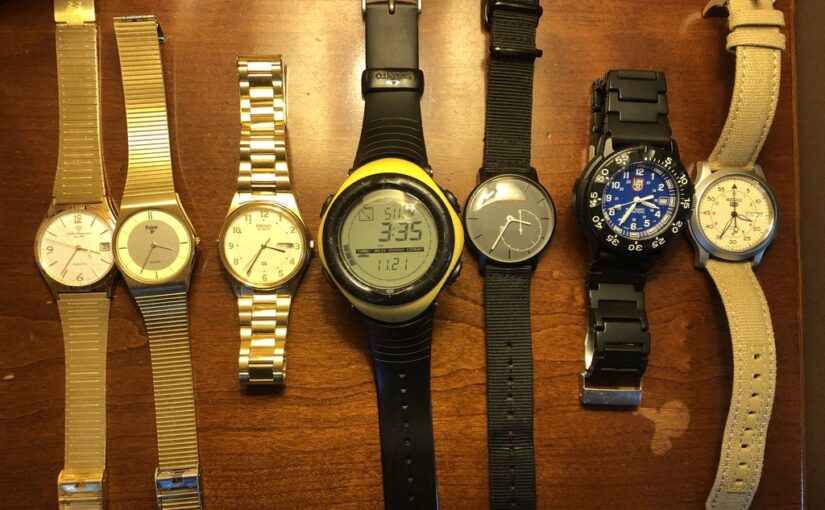
    Current watch collection

    I’ve always enjoyed watches, from the time I was perhaps 10 or so. I remember the first watch I had, which was a men’s watch, was too big for my wrist, and we had to put another hole in the strap. It was an analog watch with day and date display. I think I had two analog, wind-up wristwatches before I moved on to digital watches. My best friend growing up had an early Texas Instruments LED watch, a lot like this one:

    Photo credit — Joe Haupt, flickr

    The interesting thing about LED watches was that you had to push a button to get the time to display. Otherwise the display was off. A few years later, I did get a digital watch but by then the displays were LCD and always on. I went through a digital watch phase, and those were what I wore through college. I think it was just after college, or maybe towards the end, when I leaned back towards analog, and got a watch that was somewhat like this Casio model:

    Casio AQ-230GA-9DMQ from casio-intl.com

    The one I had, as I recall, was darker in color. It had an address book function, where you could laboriously enter in contact info via the three or four buttons available. I definitely entered some in, but back then, I had few enough contacts, and a good enough memory, that I didn’t really need to. But I did like that watch, and thought it was pretty elegant looking.

    Best I can remember, that’s the last watch I no longer have. Back in the late 1980’s and early 1990’s, I worked in Boston and Cambridge, and there was a department store in Downtown Crossing called Filene’s, and in their basement, they would sell merchandise that wasn’t selling upstairs, and there was an automatic markdown process, so that the longer anything was there, the more steeply it was discounted. Filene’s Basement is where the first two watches in the top picture came from. The first is a Jules Jergensen, and is nothing special. I think I bought it because I thought it was a bargain. The next one to the right is a very thin Pulsar, which in fact I still find to be pretty good looking. After that is a very lovely and classy Seiko Quartz, which Susan bought me as a wedding present. Next comes my Suunto Vector, which I loved dearly for many years. It has a digital compass and altimeter/barometer. Great for hiking. And while it’s been a long time since I used it regularly, I found the four button user interface to be really well thought out and consistent through all its many modes and sub-modes.

    To the right of the Suunto is a Withings Activité Pop, which I feel is a great “smart” watch. Its main claim to fame is step counting, and it displays your progress towards your goal on the inner dial. It uploads the data to your smart phone via bluetooth, and of course also sets the time that way. First (only) watch I’ve had that would adjust to DST at least semi automatically. It uses a disposable battery, but the battery lasts many months. It’s really a nice implementation, and I think it has a nice casual, though elegant, look.

    Second to last is another prized possession — a Luminox. It’s one of their least expensive models, but it handles time-telling duties quite well. The big selling point of Luminox is their “lume” — tiny tritium vials on the hands and the hour markers (and the bezel!) which is always active and requires no “charging.” It’s supposed to last about 20 years. I’ve had it somewhere between 5 and 10 years, and you can tell it’s not as bright as it once was, but still very functional and readable in darkness. Ironically, it was this watch, my newest at the time, that had ceased working reliably first. Bringing it in to get serviced was what inspired me to track down all the others, so I’d have something to wear. They all seem to be working just fine.

    And finally there is my most recent acquisition, a Seiko 5 SNK803, which is currently the watch I’m wearing daily. The thing that attracted me to this one is the fact that it’s an “automatic” watch, which means it uses a traditional watch spring and escapement to measure time, instead of a quartz crystal and battery. But instead of winding it by hand via the crown, your normal daily movements are supposed to keep it wound, by virtue of a an off-balance weight that swings around a pivot and winds the watch spring that way. It supposedly has approximately 40 hours of “reserve power” so you could put it down for a day, and pick it up the next day, and it should be fine.

    The quartz watches are really pretty accurate. Mechanical watches struggle to replicate quartz’ accuracy, even at the very high end of the market. But I just love the idea of the watch winding itself this way. Mechanical engineers are genius!